portfolio detail
Vancouver tree service SEO and web development
SEO & Web Development

Tree Care SEO & Website Rebuild.

Vancouver tree service SEO and web development for an established arborist company — 190 posts migrated, 12 service pages, 10 location pages. Every one of them optimized to rank.

Next.jsHeadless CMSGSAPCompact Keywords SEOVercelSchema.org
Scroll to explore
190+

Pages Migrated

12

Service Pages

10

Location Pages

Tree Care SEO & Website Rebuild
(How We Built It)
01

Challenge

A long-established tree care business with a dated WordPress site, broken redirects, unindexed service pages, and zero structured data. Google could not find their best content.

02

Approach

Rebuilt the entire site on a modern headless stack. Migrated 190 blog posts, created 12 dedicated service pages and 10 location pages, implemented enterprise-grade schema markup, and ran a full Compact Keywords audit against live search performance data.

03

Results

Every service page is now individually indexed with keyword-first titles, schema markup, and proper redirect chains. The SEO foundation went from patchwork to bulletproof.

(Screenshots)
Tree Care SEO & Website Rebuild screenshot 1
Tree Care SEO & Website Rebuild

The full story behind Tree Care SEO & Website Rebuild.

(Case Study)
01

An established business with a website that fought against it

This arborist and tree-care company has served Greater Vancouver for two decades. Certified arborists. A strong local reputation and a deep review history. The kind of credibility that should dominate local search.

But when we ran the numbers, the picture was ugly.

The WordPress site was slow. The design looked like it was built from a theme and never touched again. Service pages used generic slugs that did not match what people actually searched for. Blog posts — 190 of them — were buried under a content structure that made them nearly invisible to Google.

The real problem showed up in the search performance data. Their single most valuable commercial keyword was sitting on page two, collecting impressions and almost no clicks. For a business with two decades of credibility, page two is unacceptable.

Worse: most of their service pages were not indexed at all. Google literally did not know these pages existed. The old redirects were broken — pointing to URLs that had been renamed during an earlier migration and never updated. Link equity from years of backlinks was leaking into 404s.

02

Tearing it down and rebuilding from the data up

We did not start with design. We started with the search performance data.

We pulled 28 days of live query data: every query, every impression, every click, every position. We cross-referenced it with analytics session data to understand which pages people actually engaged with versus which ones they bounced from.

Then we ran the Compact Keywords audit. This framework checks whether every bottom-of-funnel page has the target keyword in six positions: URL, page title, meta description, H1, first sentence, and first image alt text. The results were grim. Most service pages failed on three or more positions.

Here is what we fixed:

Five legacy redirect destinations were pointing at slugs that no longer existed — the main removal service, stump grinding, and hedge trimming among them. Every one of those was a broken chain bleeding ranking signals.

We rebuilt 12 service pages with keyword-first titles. "Tree Removal Vancouver" instead of "Our Tree Removal Services." "Hedge Trimming Vancouver" instead of "Hedge Services." Simple changes. Massive impact on how Google categorizes these pages.

The schema markup went from zero to enterprise-grade: LocalBusiness schema with AggregateRating, service schema on every service page, breadcrumb schema on every route, FAQ schema on high-intent pages, and entity linking across twenty-plus arboriculture terms.

We added trust and certification badges as real image assets in both the homepage trust strip and the footer. These are not just visual signals — they reinforce the experience and trust signals Google weighs for local service businesses.

03

The design had to match the reputation

This company charges premium rates. Their crew shows up with professional equipment, follows industry safety protocols, and delivers results that justify the price. The website needed to communicate that same level of quality.

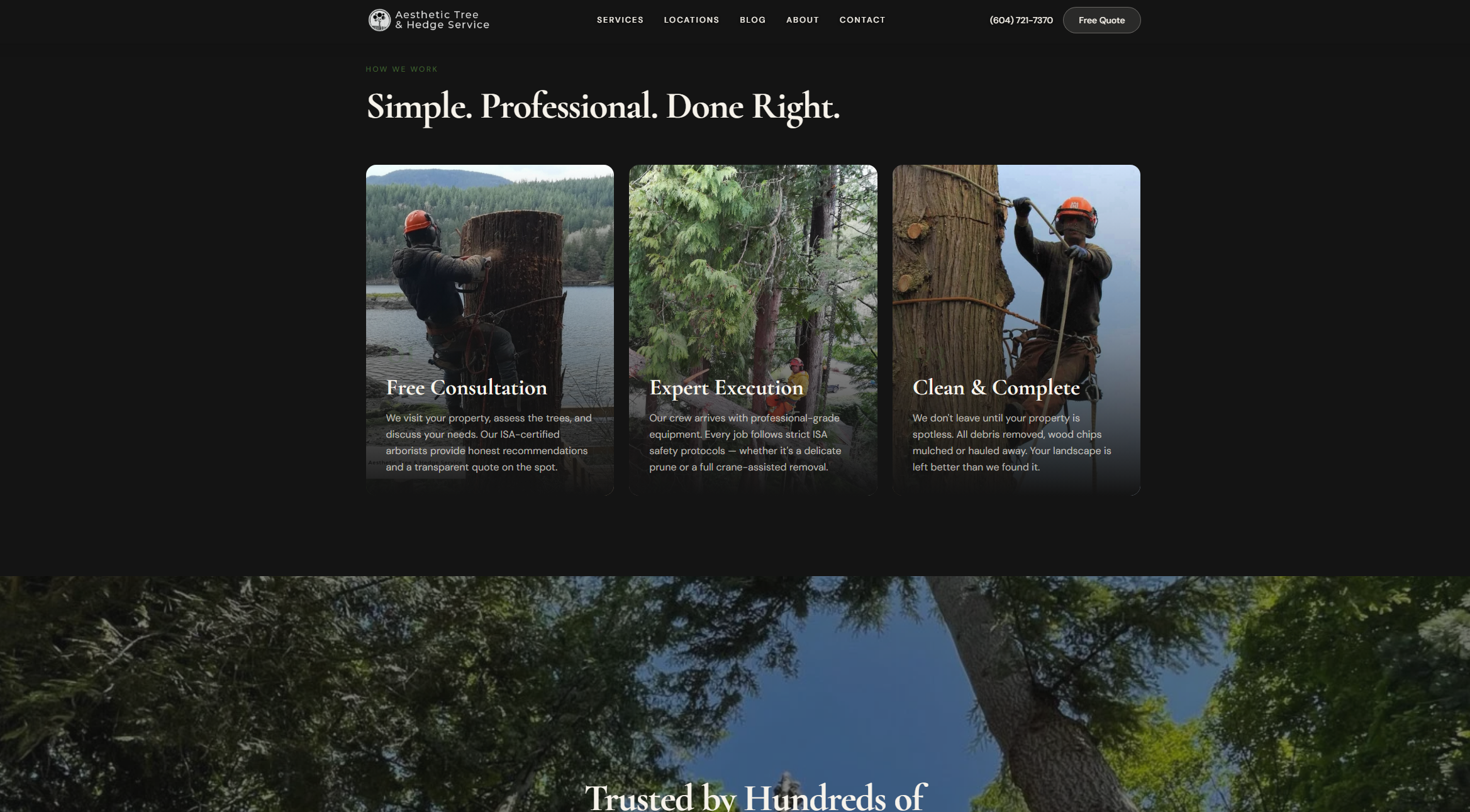
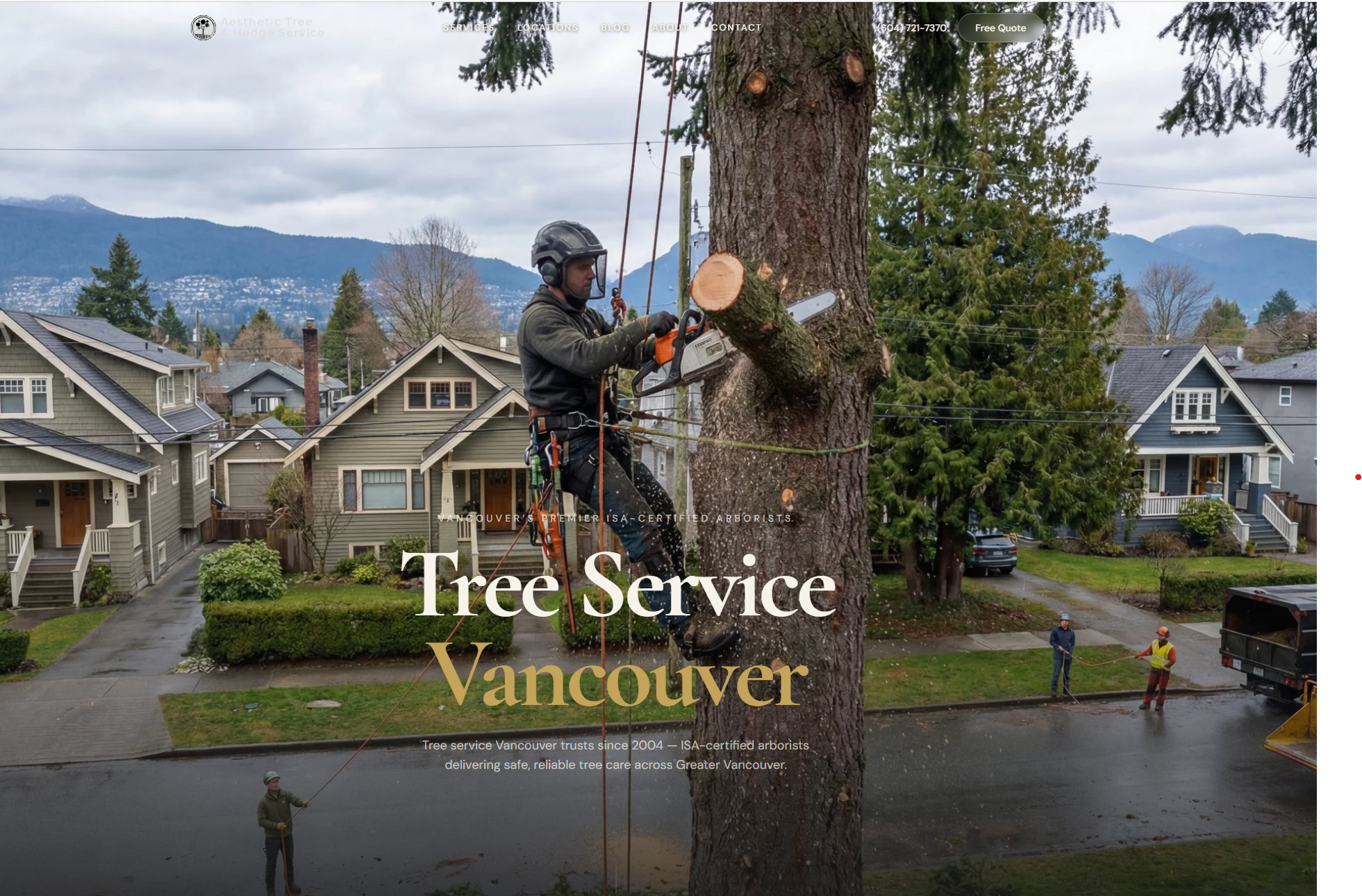
We replaced the WordPress theme with a GSAP-animated editorial design. Full-height hero sections with sharp photography. Parallax scroll effects on service imagery. Layered compositions with glassmorphism accents. A magazine-style project gallery with horizontal scroll. No card grids.

The homepage features a trust marquee, a service grid with diagonal reveals, a layered about section with overlapping images and a glass quote card, and a horizontal project scroller. Every animation is purposeful — nothing moves just to move.

Typography is deliberate: Cormorant Garamond for headings, DM Sans for body. The palette is dark forest greens, warm golds, and cream. It reads as premium without trying to look like a tech startup.

Every blog post carries a brand watermark on images. Every page has unique imagery — no reuse across the site. Internal links are woven throughout article body copy, not clustered at the bottom.

04

What the data says now

The site is live. The redirects are fixed. The schema is deployed. The service pages exist as individual, indexable routes with keyword-optimized metadata.

The head terms that were already within striking distance now have properly optimized service pages built to hold and improve those positions, with benefit modifiers in the title tags to lift click-through on queries that were collecting impressions but not clicks.

The service pages that were previously invisible to Google — removal, stump grinding, hedge trimming, tree cutting, arborist reports — are now individually indexed with correct canonical URLs, structured data, and keyword-first metadata.

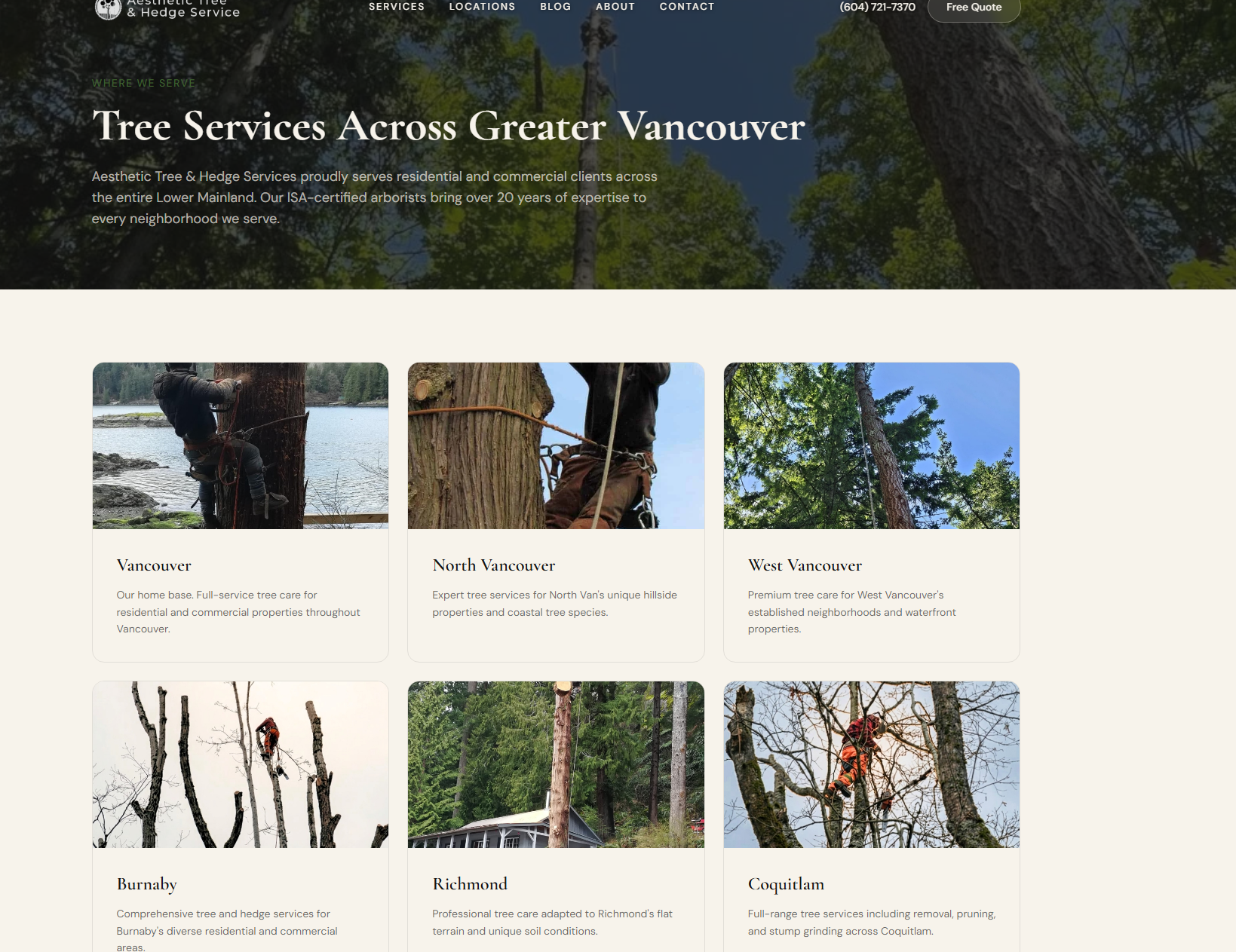
Stale legacy sitemaps were removed from Search Console and the correct sitemap submitted. Location pages across ten Greater Vancouver cities are now discoverable.

The SEO work is not done. It is never done. But the foundation is no longer the bottleneck. The site now has the architecture to rank — which is the part that most rebuilds skip.

Want Something Like This?

Every project starts with a conversation. Tell me the problem — I'll show you the system that solves it.