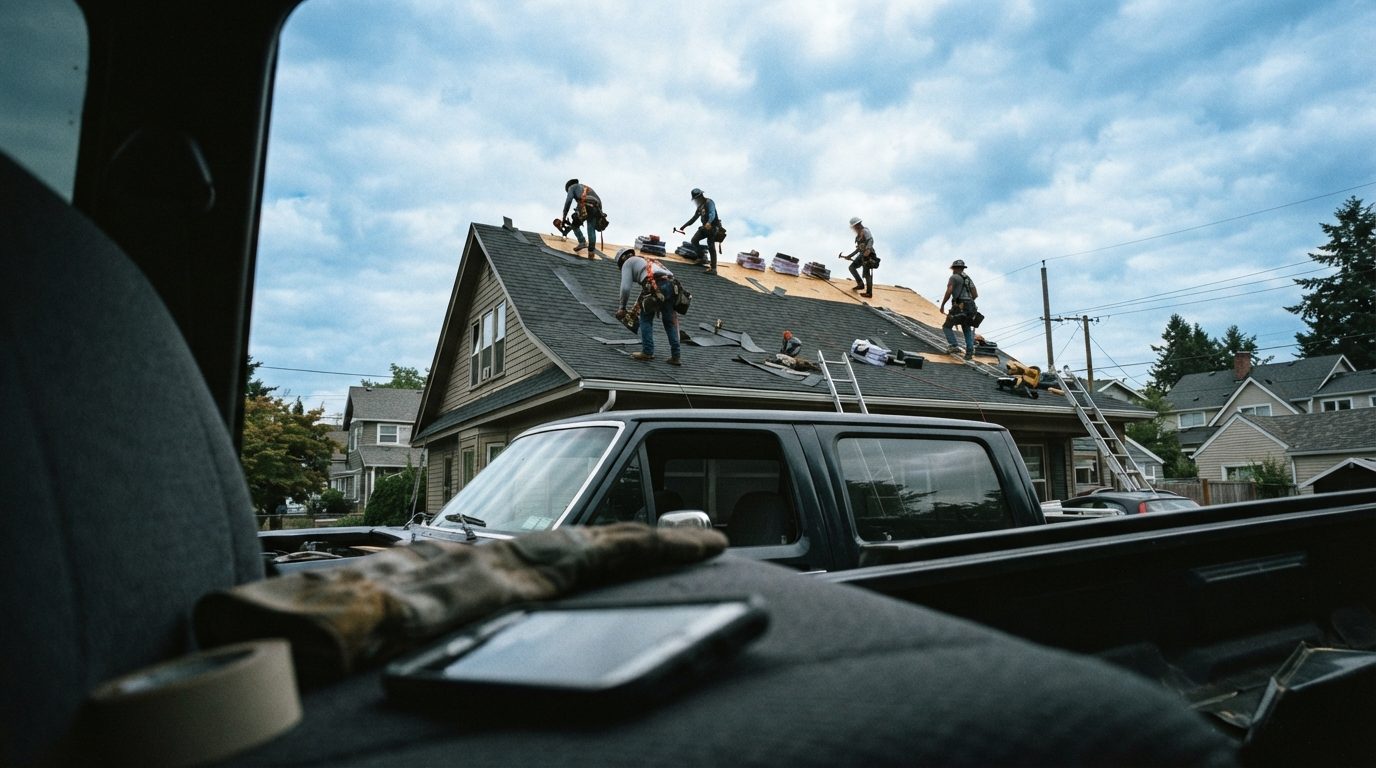
Missed-Call Recovery and Estimate Booking for a Roofing Company
AI AutomationIn collaboration with Visionary Automate

Missed-Call Recovery and Estimate Booking for a Roofing Company.

Roofing crews cannot answer a phone from a roof, so calls went to voicemail and stayed there. We built instant missed-call text-back with qualification and estimate booking attached. Delivered in collaboration with Visionary Automate, a systems-integration partner of Zealous Digital Solutions.
Missed-call text-backSMS automationLead qualificationAppointment schedulingCRM automation
往下探索
$72K to $108K

Modeled annual value

1 to 1.5/month (est.)

Modeled recovered jobs

~18/month (est.)

Modeled calls at risk

Missed-Call Recovery and Estimate Booking for a Roofing Company
(How We Built It)
01

Challenge

Crews on a roof cannot take a call. CallRail benchmark data puts home services at roughly a 14 percent missed-call rate, spiking during storm season, and around 85 percent of unanswered callers never try again.

02

Approach

Built an instant text-back that fires within seconds of a missed call, runs a short qualification covering roof type, issue, address and urgency, books an estimate, and routes the job request to the owner.

03

Results

A missed call now starts a conversation instead of ending one. The job-value figures on this page are modeled from the company's own call volume and industry replacement costs, not measured.

Missed-Call Recovery and Estimate Booking for a Roofing Company

The full story behind Missed-Call Recovery and Estimate Booking for a Roofing Company.

(Case Study)
01

The situation

A roofing company had the problem every trade with crews in the field has. The people who can answer questions about a roof are standing on one.

CallRail's tracked data puts home services at roughly a 14 percent missed-call rate, and that figure gets much worse during storm season, which is exactly when the calls are most valuable and most urgent. Around 85 percent of people who reach a voicemail at a home services business never call back. They call the next roofer.

The company was taking about 150 calls a month. That put roughly 21 missed, and roughly 18 of those permanently lost on the benchmark rate. An average roof replacement in the United States runs around $9,500 according to Angi and HomeAdvisor data, though a real mix of repairs and replacements sits lower than that.

The owner knew the calls were being missed. There was no realistic fix inside the existing setup, because hiring a full-time person to answer a phone that rings 150 times a month is hard to justify, and asking a crew to stop working to answer it is worse.

Delivered in collaboration with Visionary Automate, a systems-integration partner of Zealous Digital Solutions.

02

What was built

The core of it is a text message that fires within seconds of a missed call. Not minutes. Seconds, while the caller still has the phone in their hand and has not yet dialled the next company on the list.

That message opens a qualification conversation rather than apologising. It establishes roof type, what has actually gone wrong, the property address and how urgent it is. Urgency is the field that changes the routing: an active leak during rain is not the same request as a quote for replacing shingles next spring, and treating them identically is how a roofer loses the emergency and wins the tyre-kicker.

From there the conversation books an estimate directly into the schedule, so the caller gets a time rather than a promise of a callback.

Qualified job requests route to the owner with the whole exchange attached. During a storm surge the same flow handles ten simultaneous conversations without any change in behaviour, which is the part a human answering service cannot match.

The triage rules and the booking integration were specified and built jointly. Delivered in collaboration with Visionary Automate, a systems-integration partner of Zealous Digital Solutions.

03

How the ROI model was built

These figures are modeled from the company's stated call volume and published industry cost data. They are not audited results. The assumptions:

• Roughly 150 inbound calls per month • A 14 percent missed-call rate, per CallRail benchmark data for home services • That gives about 21 missed calls a month • 85 percent of those never calling back, or roughly 18 permanently lost per month • Only 5 to 8 percent of those lost calls recovered by the text-back, not a majority • That gives 1 to 1.5 additional jobs per month • Average US roof replacement around $9,500 per Angi and HomeAdvisor data, modeled at a blended $6,000 to account for repairs in the mix • Storm-season surge capacity treated as included rather than valued separately

That models out to a modeled annual benefit of $72,000 to $108,000. No payback period is claimed for this build. Actual results depend on the client's baseline and adoption. These figures are modeled estimates, not measured client results.

04

What changed operationally

A missed call stopped being a dead end. The crew still cannot answer, and that has not changed and does not need to. What changed is what happens in the ninety seconds afterwards.

Emergency work started getting separated from quote requests automatically. That is the operational change with the most immediate effect, because an active leak booked same-day is both the most profitable job and the one most likely to be lost to whoever picks up first.

Estimate scheduling stopped being a phone tag exercise. The caller picks a slot inside the conversation, which removes two or three rounds of missed calls in the other direction.

Storm season stopped being a capacity cliff. When call volume triples for a week, the qualification layer handles it without the owner triaging voicemails at eleven at night.

The urgency specification was handed over as a written joint deliverable, so the owner can change a rule without calling anyone. Delivered in collaboration with Visionary Automate, a systems-integration partner of Zealous Digital Solutions.

05

Who this fits

This fits a roofing, HVAC, plumbing, electrical, restoration or similar trade business taking 80 or more calls a month with crews in the field and no dedicated full-time phone coverage.

It is aimed at United States owner-operators and is region agnostic, though it is worth more in markets with storm-driven demand spikes, where the surge is precisely when calls are missed and precisely when jobs are largest.

It fits best where the average job value is in the thousands rather than the hundreds, because a single recovered job pays for a lot of automation. It is a poor fit for trades with very low ticket values and very high call volumes, where a different economic model applies.

06

What the first 30 days look like

Four weeks, and the build is deliberately live early because the cost of a missed call does not pause for a project plan.

• Week 1, discovery and data access. We connect to the phone system, define what counts as a missed call, and write the urgency rules with the owner: what is an active leak, what is storm damage, what is a quote for next spring. Deliverable: a written triage specification and the routing rule for each category. • Week 2, build. The text-back trigger is wired to the phone system, the qualification conversation is written to the company's own language, and estimate booking is connected to the schedule. Deliverable: test conversations covering an emergency, a routine quote, an insurance claim question and a wrong number. • Week 3, supervised pilot. Text-back runs live with the owner reading every conversation the same day. Deliverable: a correction log, which in roofing is almost entirely about urgency classification rather than about the messaging. • Week 4, cutover. Every missed call triggers the flow, estimates book directly into the calendar, and job requests route to the owner with the exchange attached.

Going live in week 3 rather than week 4 is intentional. A roofing company waiting a month to switch on has spent a month of missed calls proving the problem it already knew about.

07

What you need in place before this works

Six prerequisites, and the second one is the one owners have usually not thought about.

• A business phone number that can report missed calls to an integration, or that can be forwarded through one. This is the single technical dependency and most modern systems handle it. • Estimate capacity in the calendar. The text-back books appointments, so somebody has to be available to attend them. A company already booked six weeks out will convert the emergency work and frustrate everyone else. • Written urgency rules agreed by the owner. An active leak during rain and a shingle quote for spring are different businesses, and the rule that separates them has to exist before the conversation can apply it. • A scheduling system the flow can write into, even a shared calendar. • A named person who receives qualified job requests, especially during storm season when volume spikes. • A settled position on messaging consent for the jurisdictions you serve, since the first contact is an outbound text to somebody who just called you.

08

Questions buyers ask before committing

What happens when the conversation cannot classify the job?

It routes to the owner with everything captured so far, and it defaults to treating unclear urgency as urgent rather than routine. That default is deliberate. Misclassifying an active leak as a spring quote costs a job and a reputation, while misclassifying a spring quote as urgent costs a phone call. Insurance claim questions, anything about a previous repair and anything involving a structural concern route to a person immediately.

Who owns the phone number and the customer conversations?

The company does. The number stays in the company's account, conversation history and booked estimates sit in systems the company controls, and nothing routes through infrastructure you cannot switch off. If the flow is removed, missed calls simply go back to voicemail.

What drives the ongoing running cost?

Missed-call volume, messaging traffic per conversation, and seasonality. Storm season is the honest answer here. A roofing company's message volume in a bad week can run several times its normal month, and that surge is exactly when the system is worth the most and costs the most. Retention of conversation history is a smaller third factor.

How is success measured in the first 90 days?

Four numbers, three capturable from your phone records today. Missed calls per month, percentage of missed calls that start a conversation, estimates booked from those conversations, and jobs won from those estimates. The middle two move in the first fortnight. Jobs won is seasonal, so read it against the same period last year rather than against last month.

09

Where this is the wrong fit

Four situations where the arithmetic does not work.

• Trades with very low ticket values and very high call volume, where a recovered job does not pay for the conversation that recovered it. • Companies with no estimate capacity. Booking appointments you cannot attend converts a missed call into a broken promise, which is worse. • Businesses under about 80 calls a month, where the recovered volume is too small to register against anything else. • Companies that have not settled outbound messaging consent for their service area.

The strongest fit signal is the opposite of all four: average job value in the thousands, crews genuinely unable to answer, and a storm-driven demand pattern that spikes exactly when the phone goes unanswered.

10

About this engagement

Delivered in collaboration with Visionary Automate, a systems-integration partner of Zealous Digital Solutions.

The company is not named and no service area, crew member or customer is identified. The build described here is real and in production.

The job-value figures are not measured results. They are modeled from the company's stated call volume, from CallRail's published missed-call benchmarks for home services, and from Angi and HomeAdvisor replacement cost data, deliberately discounted to a blended figure. Actual results depend on the client's baseline and adoption. These figures are modeled estimates, not measured client results.

If your crews are on a roof while your phone rings, nothing about that is going to change, and it does not need to. What can change is the ninety seconds afterwards. Start a conversation with your monthly call volume, your average job value and your phone system, and we will model the recovery against your numbers.

Want Something Like This?

Every project starts with a conversation. Tell me the problem and I will show you the system that solves it, with the arithmetic behind it before you commit to anything.

In collaboration with Visionary Automate. Figures shown on this page are modeled estimates for a typical business of this profile, not measured client results.