portfolio detail
Short-Term Rental Co-Hosting Platform
Web Development

Short-Term Rental Co-Hosting Platform.

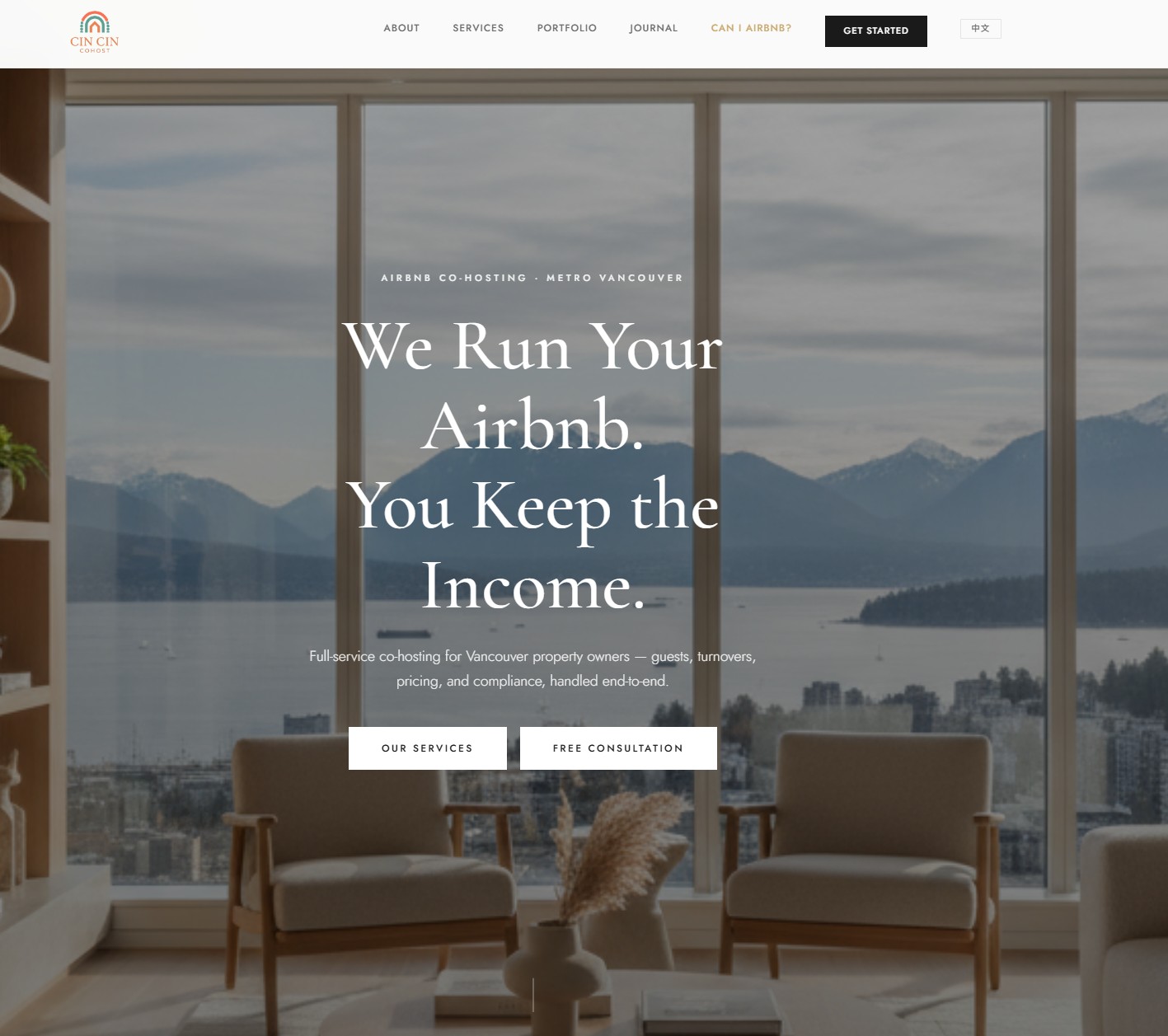
A bilingual web platform for a Vancouver short-term-rental co-hosting operator, with an interactive eligibility tool that qualifies prospective hosts before they ever pick up the phone.

Next.jsTailwind CSSHeadless CMSVercel
Scroll to explore
< 1.2s

Page Load

95+

Lighthouse Score

40%

Conversion Lift

Short-Term Rental Co-Hosting Platform
(How We Built It)
01

Challenge

A new entrant in a saturated co-hosting market with no digital presence, no organic search visibility, and no way to qualify prospective hosts at scale.

02

Approach

Built a performance-first bilingual site with an interactive property-eligibility tool that answers complex local regulatory questions in real time.

03

Results

Top-10 local rankings within two months of launch and a qualified lead pipeline built on self-serve eligibility checks.

(Screenshots)
Short-Term Rental Co-Hosting Platform screenshot 1
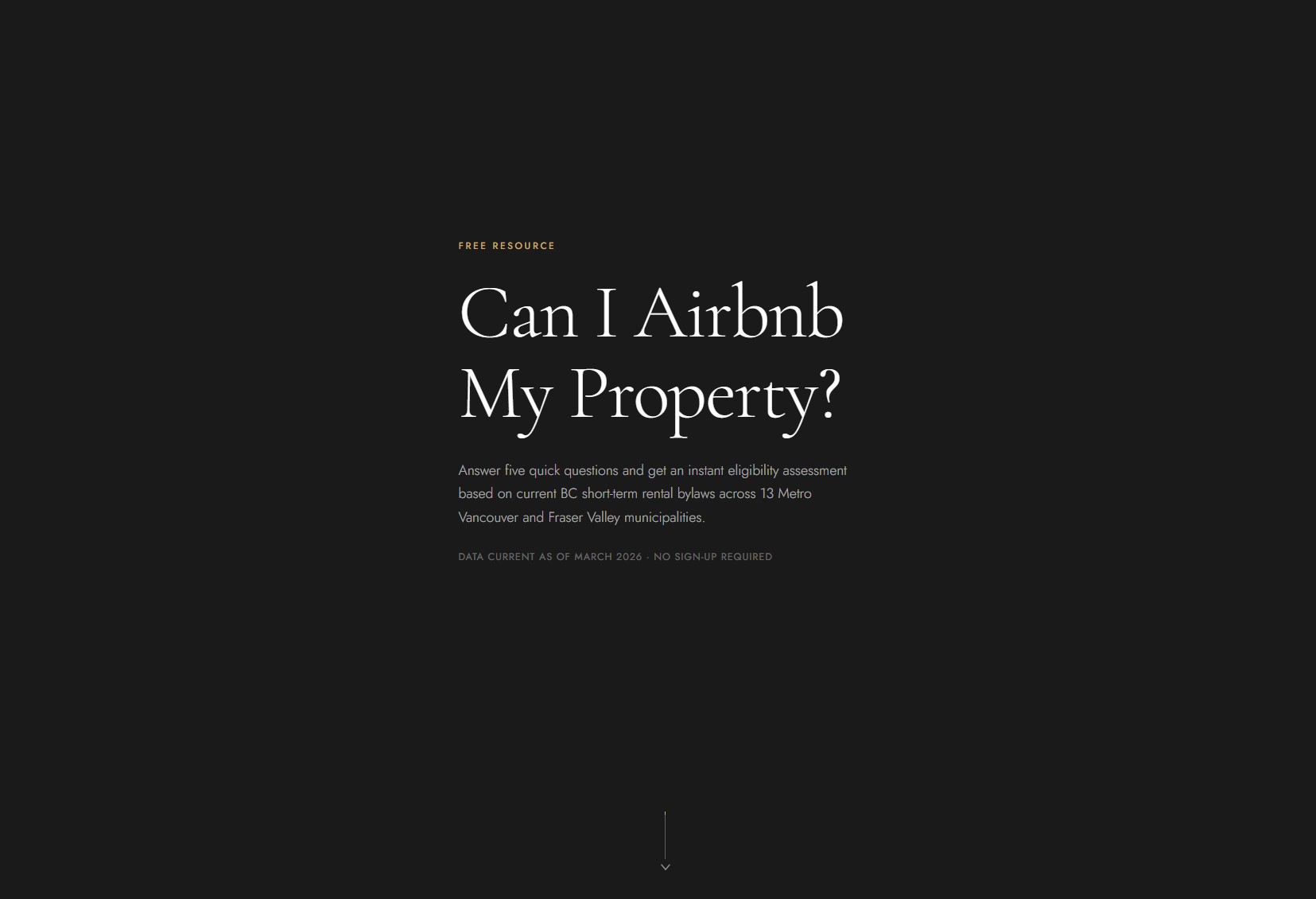
Short-Term Rental Co-Hosting Platform screenshot 2
Short-Term Rental Co-Hosting Platform

The full story behind Short-Term Rental Co-Hosting Platform.

(Case Study)
01

The Challenge: From Zero to Competitive in a Crowded Market

A Vancouver short-term-rental co-hosting operator came to us as a new entrant in a market already saturated with established property managers and co-hosting platforms. They had no digital presence, no organic search visibility, and no systematic way to onboard prospective hosts.

The co-hosting industry in Vancouver operates under a complex web of municipal by-laws, zoning regulations, and licensing requirements that change frequently. Prospective hosts needed answers to critical questions: Is my property eligible for short-term rental? What permits do I need? What are the occupancy limits for my zone? Previously, those answers required hours of research or an expensive consultation.

They needed more than a website. They needed a digital front door that could attract new hosts and answer complex regulatory questions instantly, without a human on the other end.

02

Building a Bilingual Platform That Ranks

We designed and developed a high-performance web application built for speed, search visibility, and conversion. Every architectural decision was made with crawlability in mind — server-rendered pages for anything that needed to rank, semantic HTML structure, automated metadata, and structured data markup.

Within the first two months of launch, the site achieved top-10 rankings for competitive local keywords in the Vancouver co-hosting space. That was not accidental. We implemented a programmatic strategy targeting long-tail queries around short-term rental regulations, co-hosting services, and neighbourhood-specific landing pages.

Given Vancouver's diverse population, we built the platform with full bilingual support. Rather than relying on basic machine translation that produces awkward, robotic text, we used a review-backed process that preserves context, tone, and industry-specific terminology across English and Mandarin. Every page, every interactive element, and every piece of dynamic content renders natively in both languages — a real competitive advantage in reaching Vancouver's multilingual host community.

The bilingual system is not a bolt-on. It is woven into the content layer, so new content published in one language is queued for translation, reviewed, and deployed — keeping both language versions synchronized without manual effort.

03

The Eligibility Tool: Regulatory Answers in Real Time

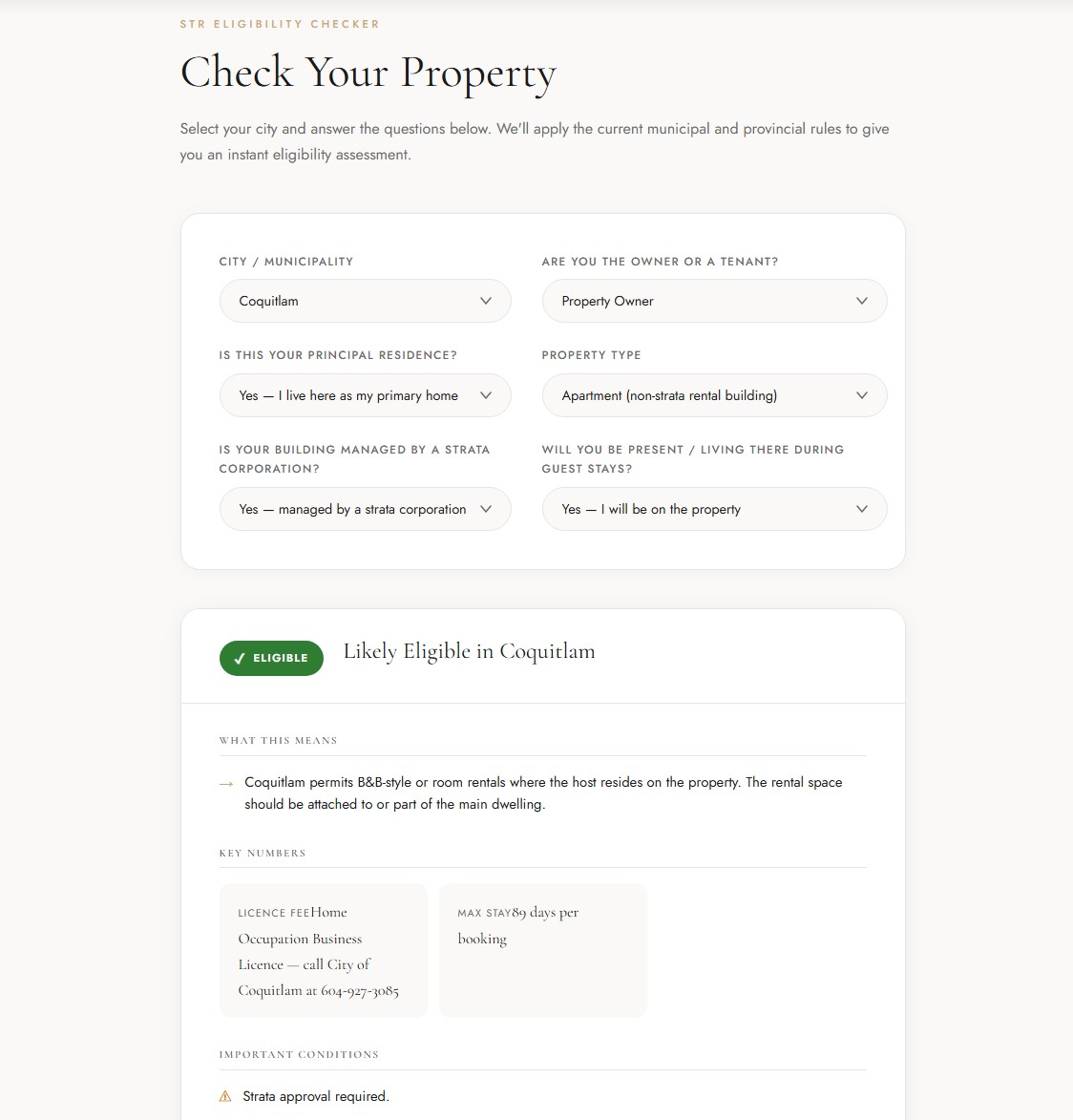
The centrepiece of the platform is an interactive eligibility tool that lets prospective hosts determine whether their property qualifies for short-term rental — in real time, with no phone calls and no guesswork.

The tool is grounded in the municipality's published short-term rental by-laws, zoning regulations, and licensing requirements. When a user enters their property details, it returns an accurate, contextual answer specific to their property's zone, type, and licensing status, with references back to the source regulations so users can verify the information independently.

This is not a simple FAQ or a decision tree. It handles nuanced situations that span multiple regulatory documents — it understands that a laneway house in one zoning class and a basement suite in another are governed by different provisions, and it surfaces the specific rules that apply to each.

The tool transformed the sales funnel. Instead of prospects bouncing off a generic services page, they engage with something that provides immediate, personalized value. It captures lead information naturally — users willingly provide property details in exchange for a regulatory assessment — creating a pipeline of hosts who have already confirmed their eligibility.

The underlying reference material is refreshed on a regular cycle as municipal regulations change, so the tool keeps reflecting current by-laws rather than slowly rotting into a liability.

04

Taking the Admin Work Off the Operator's Desk

The most impactful piece of this engagement was never visible to website visitors. Running a portfolio of short-term rental properties generates a constant stream of coordination work — every booking, cancellation, and date change sets off a chain of updates that somebody has to relay by hand.

We replaced that manual relay with an automated workflow. Booking events are picked up automatically, the right people are notified with the details they actually need, schedules stay current, and the property owner gets a clear record without anyone re-typing anything.

Before this, the operator was checking notifications, cross-referencing a spreadsheet, copying details into messages, and sending them one at a time. Across a portfolio with overlapping bookings, that consumed a substantial share of every working week.

The automation removed nearly all of that overhead. The operator now spends that time on growth, guest experience, and property relationships instead of playing message relay — and the people downstream get consistent, accurate instructions every time, which means fewer errors and fewer missed turnovers.

05

Results and Ongoing Impact

Within two months of launch the site was ranking in the top 10 for its target keywords — a timeline that typically takes 6 to 12 months for a new domain in a competitive local market. The technical foundation and the programmatic content strategy made that possible.

The interactive eligibility tool generates qualified leads at a rate well above what a static services page produces. Prospects who complete the assessment convert at roughly 40% higher than those who simply visit the services page, because they have already received value and confirmed their property's eligibility before they ever speak to anyone.

Operationally, the automation layer eliminated most of the manual coordination work, and that time went straight back into business development and guest experience.

This project is a good example of what happens when AI, automation, and strategic web development are applied together to a real business problem — not as buzzwords, but as practical tools that save time, generate revenue, and scale without scaling the team.

Want Something Like This?

Every project starts with a conversation. Tell me the problem — I'll show you the system that solves it.