AI Automation发布于2026年6月20日

Most AI-Search Tools Just Watch. I Built One That Acts.

Most AI-visibility tools stop at a dashboard — they tell you where you stand when buyers ask AI for a recommendation, then leave the work to you. Here’s the autonomous system I built to close that loop: it finds the questions you don’t answer, fills the highest-value gaps automatically, and proves the result.

作者:Frank Yao

摘要

Buyers increasingly ask AI engines which company to choose. Most tools only measure whether you show up. I built a system that closes the loop — it finds the questions your site doesn’t answer, automatically turns the highest-value gaps into published content, and tracks the wins. No dashboard to babysit.

Most AI-Search Tools Just Watch. I Built One That Acts.
Frank Yao

Quick Check

对还是错:AI 工具将在 2 年内完全取代 SEO 的需求。

The search bar changed shape, and most businesses haven’t noticed. People used to type a few words and scan ten blue links. Now they ask a full question — “who’s the best option for this near me?” — and an AI engine hands back a short, confident answer. If your business is in that answer, you’re on the shortlist. If you’re not, you may as well not exist for that buyer.

I’ve spent a stretch of time on one problem: not just knowing whether AI engines recommend you, but doing something about it — automatically. Here’s what I found, and what I built.

Measuring isn’t winning

A dashboard that tells you you’re invisible is not a solution. It’s a to-do list you still have to work.

There’s a whole category of tools now that will show you, on a tidy chart, how often the major AI engines mention your brand versus your competitors. That’s genuinely useful — and it stops exactly where the value starts. The chart says “you’re missing from these answers,” and then a human has to read it, decide what to write, brief a writer, publish, and check back weeks later. The loop stays open. The dashboard nags; nothing acts.

When I looked closely at even the best-funded tools in this space, that was the pattern: excellent at measuring, silent on acting. The hard, valuable half — turning a gap into published, citation-worthy content — was left to people.

The system I built closes the loop

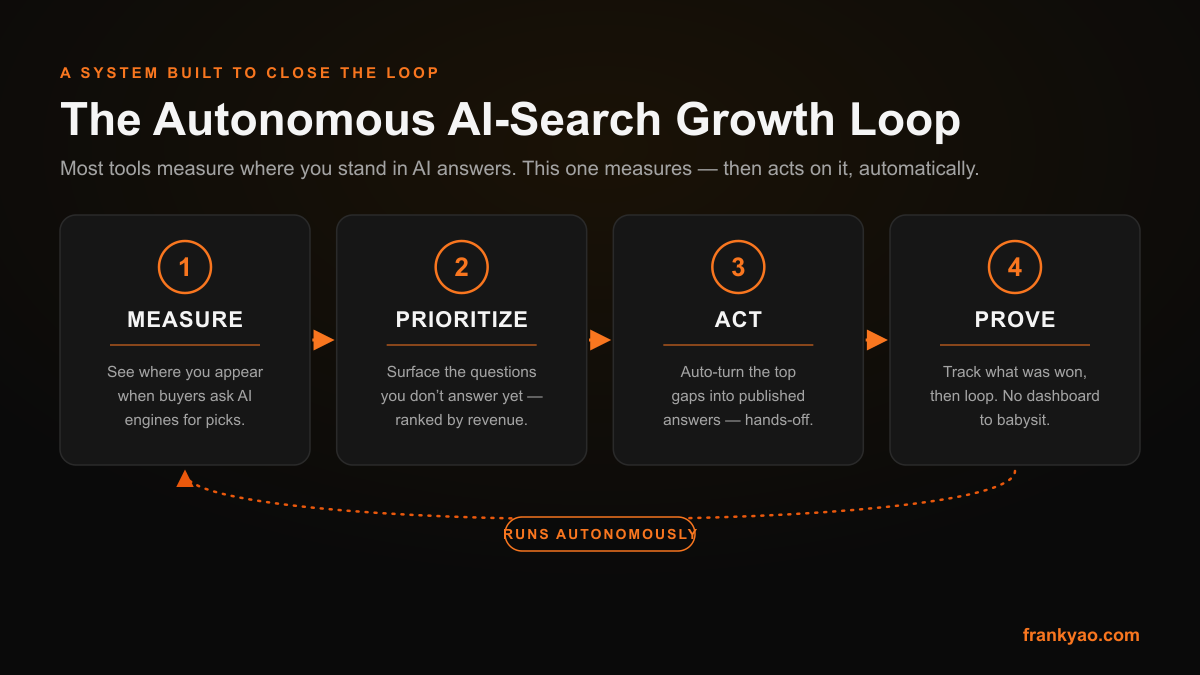
Instead of a dashboard that reports gaps, I built a system that fills them on its own. It runs in four moves, on repeat:

  • Measure — it checks where you actually show up when buyers ask AI engines for recommendations in your category.
  • Prioritize — it surfaces the exact questions real buyers ask that your site doesn’t answer yet, ranked by commercial value, not vanity.
  • Act — it automatically turns the highest-value gaps into published answers — drafted, quality-checked, and shipped, with guardrails so nothing low-quality or off-brand goes out.
  • Prove — it tracks what was won and feeds that back into the next cycle.

The point isn’t any single step — plenty of tools do one of them. The point is that the four are wired together and run without anyone standing over them.

What “autonomous” actually means here

Autonomous means a person sets direction once and the system does the weekly work — not that a person watches a dashboard and reacts.

Every week, on its own, it finds fresh questions, checks them against what’s already published, fills the gaps that matter, and leaves a record of what it did. There’s a heartbeat on it, so if any part goes quiet, that silence is the alarm — not a missed month I discover later. A human only steps in for judgment: a sensitive account, a strategic bet, a number that deserves a second look. Everything routine runs itself.

That distinction matters. “AI-powered” usually means a tool that makes a human faster. This is closer to a teammate that owns a job end to end and tells you when it needs you.

Build systems that act, not dashboards that nag

I test before I recommend, and the test here was simple: does the loop close without me? It does. And the lesson generalizes well past AI search — a measurement you have to act on by hand is a cost; a measurement wired to an action that runs on its own is an asset. A lot of software sells you the first and calls it the second.

If buyers in your market are starting to ask AI who to pick — and they are — the question isn’t whether you can see where you stand. It’s whether anything happens when you don’t like the answer. That’s the gap I set out to close. The watching was never the hard part.

Where Are You Right Now?

你的业务目前在 AI 方面最大的挑战是什么?

常见问题

What is answer engine optimization (AEO)?

It’s the practice of making sure AI engines cite and recommend your business when people ask them questions — the AI-era equivalent of ranking on a results page, except the “page” is now a single synthesized answer.

How is this different from an AI-visibility dashboard?

A dashboard measures and reports; you still do the work. This system measures, then automatically fills the content gaps it finds and tracks the result — the act-and-prove half most dashboards leave to humans.

Does “autonomous” mean no human is involved at all?

No. A person sets direction and handles judgment calls — sensitive accounts, strategic bets, anything needing a second look. The routine weekly work runs on its own, with a heartbeat so any silence is treated as a failure.

Why does showing up in AI answers matter now?

Buyers increasingly ask AI engines for a recommendation and act on the shortlist they get back. If you’re not in that answer, you’re invisible to that buyer — no click, no consideration.


相关文章

准备好付诸行动?

让我们聊聊 AI 自动化和智能数字策略如何为你的业务带来实际成果。