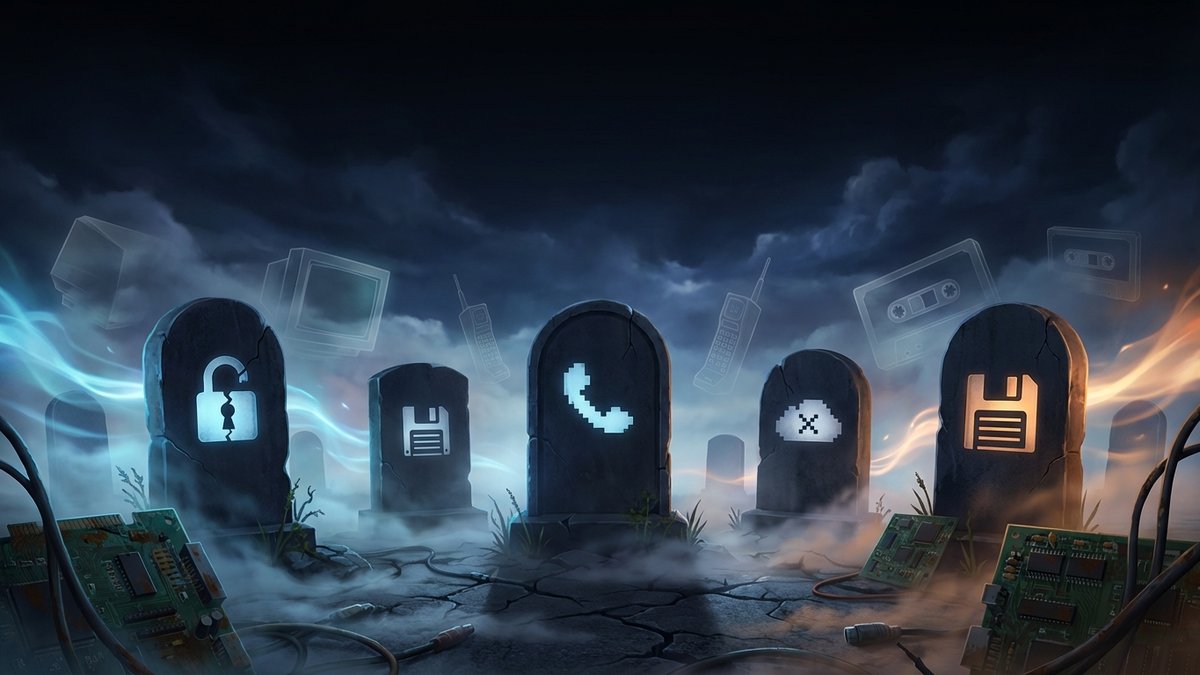
10 AI Tools That Were Everywhere in 2025 and Are Already Dead in 2026
Remember when everyone was talking about Jasper, Copy.ai, and AI-generated avatars? Here's what happened to the tools that burned bright and flamed out.
TLDR
The AI tool graveyard of 2025-2026 includes: Jasper (pivoted twice, lost 60% of subscribers to native AI in Google Docs and Notion), Copy.ai (free-tier ChatGPT made their pricing unjustifiable), Synthesia AI avatars (uncanny valley never improved, clients stopped using them), Lensa AI portraits (fad that lasted 3 months), multiple 'AI writing detectors' (accuracy never exceeded 60%, false positives killed adoption), AI-powered meeting note-takers that recorded without consent (legal crackdowns), and several 'build an app with AI' platforms that produced unmaintainable code. The lesson: tools that wrap a commodity API with a UI die when the underlying model becomes accessible directly.

Quick Check
True or false: AI tools will replace the need for SEO entirely within 2 years.
Why Do AI Tools Die So Fast?
The average lifespan of an AI startup in 2024-2025 was 14 months from launch to either pivot or shutdown. That's not normal for tech companies. The reason is structural: most AI tools are thin wrappers around foundation models (GPT-4, Claude, Gemini) with a specialized UI and prompt engineering. When the foundation model provider adds that same functionality natively — or when a free tier emerges — the wrapper tool loses its value proposition overnight.
It's like building a business selling bottled tap water. It works until people realize they can just turn on the faucet. The tools that survive are ones that add genuine value beyond the model itself: unique data, proprietary workflows, network effects, or deep integration with existing business systems.

The Content Generation Graveyard
Jasper was the poster child of the 2023-2024 AI content boom. At its peak, it was valued at $1.5 billion. By mid-2025, it had pivoted twice — first to 'AI marketing platform,' then to 'enterprise AI copilot' — and lost roughly 60% of its individual subscribers. What killed it? Google Docs got built-in AI writing. Notion added AI. Even Canva added AI text generation. Why pay $49/month for Jasper when every tool you already use can generate copy?

Copy.ai followed the same trajectory. Their pitch was 'AI writes your marketing copy.' But ChatGPT's free tier does the same thing. When your entire product is a nicer interface for GPT, you're one OpenAI pricing change away from irrelevance. Both companies still exist in some form, but they're serving enterprise customers with compliance requirements — not the small business audience they originally targeted.
What This Means for Choosing AI Tools Today
Before subscribing to any AI tool, ask three questions. First: does this tool add value beyond what ChatGPT/Claude/Gemini can do directly? If it's just a prompt template with a pretty UI, skip it. Second: what happens if the underlying AI model becomes 2x better? Does this tool's value increase or decrease? Tools that become more valuable as models improve (workflow automations, data integrations) will last. Tools that become less necessary as models improve (writing assistants, basic chatbots) won't. Third: does this tool have a moat? Proprietary data, network effects, deep integrations, or regulatory compliance that can't be replicated by the model provider adding a feature?
Related: For more on this, see MCP Explained Without the Jargon: What Model Context Protocol Means for Your Business.
Frequently Asked Questions
Are all AI writing tools dying?
Standalone AI writing tools are struggling because writing is now a commodity feature built into existing platforms. Tools that combine AI writing with unique data, workflows, or specialized knowledge (like legal writing or medical documentation) still have value. Generic 'AI writes your blog post' tools are being replaced by direct model access.
How can I avoid wasting money on AI tools that will die?
Apply the 'wrapper test': if the tool is primarily a UI layer over a foundation model, it's at risk. Look for tools with proprietary data, deep integrations with your existing stack, or workflows that would take significant effort to replicate. Also check the company's funding runway — AI startups burning cash without revenue are the first to fold.
Which AI companies are most likely to survive long-term?
Foundation model providers (Anthropic, OpenAI, Google) have the strongest position. Among tool companies, those with deep enterprise integrations (Salesforce Einstein, HubSpot AI), proprietary datasets (Bloomberg GPT, legal AI tools), or workflow moats (n8n, Zapier) are most likely to survive the shakeout.
Where Are You Right Now?
What's your biggest challenge with AI and your business right now?
Related Articles



Ready to put this into action?
Let's talk about how AI automation and smart digital strategy can drive real results for your business.
Enjoying this content? Pin us as a priority in Google.
Make us your preferred source on Google